Applications
• Primer before the final finish (plaster, single-coat render, mortar, concrete or acrylic repair putty) on low-adhesion surfaces
• Vitrified surfaces (stoneware, tile), precast concrete, plasterboard, wood, metal profiles, aluminium and galvanised steel
• Polystyrene (EPS, XPS)
• Formwork, coatings and floors with residues
Technical specifications
| Reference | 1408 (5 kg) / 1409 (15 kg) |
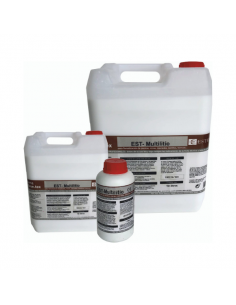
| Packaging | 5 kg or 15 kg plastic container |
| Colour | White (other colours in batches, on request) |
| Density | 1.63 ± 0.15 kg/L |
| Viscosity | 75,000 ± 15,000 cps |
| pH | 8.5 ± 1 |
| Solids | 83.6 % by weight; 72.4 % by volume |
| Dilution | Neat, or 1 part product to 1 part water |
| Theoretical yield | 0.9-1 m²/kg for 500 microns of dry film |
| Drying at 20 ºC | Touch dry 3-4 hours; fully dry 24-48 hours |
| Application conditions | 5 to 35 ºC; relative humidity < 70 % |
| VOC | Total VOC < 0.9 g/L (maximum permitted threshold: 140 g/L) |
| Shelf life | 24 months in a sealed container, in a cool place (5 to 25 ºC) |
Bonding primer with good weather resistance and good elasticity (around 160 %), with very low emissions of volatile organic compounds. Full technical documentation is in the technical data sheet downloadable above.
How is it applied?
• The surface must be dry and free of dust, grease or other contaminants that impair adhesion
• Apply with a roller, flat brush, trowel, brush or similar tool, leaving a layer of approximately 1-2 mm
• Allow to dry for at least 8 to 12 hours before applying the final coating (plaster, single-coat render, mortar, concrete or acrylic repair putty)
• Apply the material over the bonding bridge before 48 hours have passed
• On cementitious surfaces, check that their moisture content does not exceed 4 %
Substrates
Low-adhesion surfaces: vitrified (stoneware, tile), precast concrete, plasterboard, wood, metal profiles, aluminium, galvanised steel, polystyrene (EPS, XPS), formwork, coatings, floors with residues and cement-based substrates. Where there may be doubts about the anchorage, a preliminary test is recommended.
Compatibility
• ESTonetex mortars on smooth substrates: recommended primer with ESTonetex Pavimento (concrete), ESTonetex Texturest (concrete and very smooth surfaces) and ESTonetex TrabiCal
• Final finishes: plaster, single-coat render, mortar, concrete or acrylic repair putty, once the primer is dry
Observations and precautions
Do not apply below 5 ºC or above 35 ºC. If large loads of material are to be applied over the primer, fibreglass mesh or mechanical anchors are recommended. Wear gloves, goggles and a mask; do not ingest or inhale. Professional product: always consult the safety data sheet before use.
Storage
Store for up to 24 months in a sealed container, in a cool place at a temperature not below 5 ºC nor above 25 ºC. Expired product must be disposed of in accordance with current legislation.
Complementary materials
• ESTonetex Pavimento, ESTonetex Texturest and ESTonetex TrabiCal: mortars on which it is used as a primer
• ESTonetex mortars: the rest of the mortar range
Frequently asked questions
What is EST-S Imprimer used for?
To improve the adhesion of mortars and other finishes on smooth or non-absorbent substrates, such as stoneware, tile, precast concrete, wood, metal or polystyrene.
Does it need to be diluted?
It can be applied neat or diluted in water, 1 part product to 1 part water.
How long to wait before applying the finish?
At least 8 to 12 hours after applying the primer. At 20 ºC it is touch dry in 3-4 hours and fully dry in 24-48 hours; the material is applied before 48 hours have passed.
What is its yield?
Between 0.9 and 1 m² per kilo for 500 microns of dry film. A layer of approximately 1-2 mm is applied.
Can it be applied on concrete?
Yes. On cementitious surfaces, check that their moisture content does not exceed 4 %. For example, it is used to treat concrete before applying ESTonetex Pavimento.
Which containers and references does it come in?
In plastic containers of 5 kg (REF 1408) and 15 kg (REF 1409). White colour; batches in other colours can be prepared on request.
How does it differ from EST-EPS Elastic and EST-Desmoldeante?
EST-S Imprimer is applied onto the substrate, before the mortar, so that it adheres. EST-EPS Elastic is an additive added to the mixing water of the mortar and EST-Desmoldeante does exactly the opposite: it prevents the mortar from sticking to the moulds.
How long can it be stored?
Up to 24 months in a sealed container, in a cool place between 5 and 25 ºC.