


Previous
Next
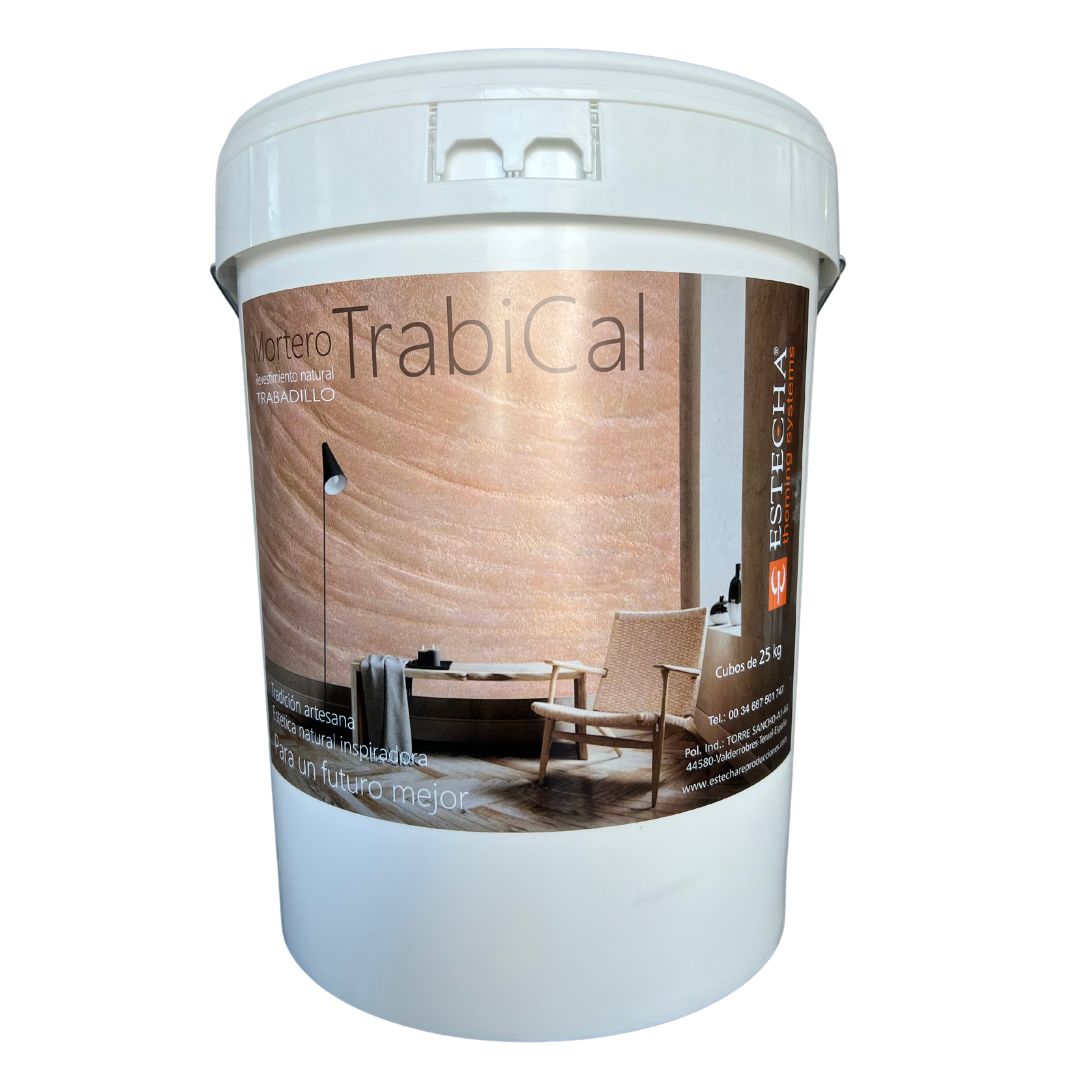
ESTonetex TrabiCal
Applications
• Interior renders and smooth or textured finishes on walls in new or existing buildings
• Microcement, stucco and travertine effects
• Interior decoration of great natural beauty in interior walls, private homes, hotels, resorts and villas
• Finish on mortar, mixed and ceramic surfaces
• Compatible with old mortars and materials: refurbishment and bioconstruction
Technical specifications
| Packaging | 25 kg plastic bucket. Pallet of 27 buckets (675 kg) |
| Reference | 1009 |
| Colour | Colour chart (can be coloured in bulk) |
| Application thickness | 2 to 12 mm in a single coat |
| Mixing water | 30% of the product weight (about 7.5 L per 25 kg bucket) |
| Consistency (flow table) | 190 mm (EN 1015-3) |
| Application temperature | Between 5 °C and 35 °C |
| Workability | 80 minutes (EN 1015-15) |
| Compressive strength | 7.8 N/mm² (EN 1015-11) |
| Flexural strength | 1.6 N/mm² (EN 1015-11) |
| Adhesion | 0.2 N/mm² on concrete and 0.4 N/mm² on ceramic substrate (EN 1015-12) |
| Apparent dry density of hardened mortar | 1,577 kg/m³ (EN 1015-10) |
| Water absorption coefficient (between 10 and 90 min) | 2.2 kg/(m²·min½) (EN 1015-18) |
| Water absorption at 24 hours | 22% (EN 1015-18) |
| Water vapour permeability | μ 8.1 to 8.6 (EN 1015-19) |
| Reaction to fire | Euroclass A1 |
| Shelf life | Up to 24 months from the date of manufacture, in the original packaging, under cover and in a dry place |
Data verified in the official technical data sheet. Full technical documentation and certificates are available on request through the contact form.
Supports
It is used as a finish on mortar, mixed and ceramic surfaces and the like, and it is compatible with old mortars and materials. The substrate must be free of dust, dirt and salt efflorescence, and any traces of oil and grease must be removed beforehand. For use only on vertical interior surfaces, as it is a completely natural product.
How is ESTonetex TrabiCal mixed?
Mix with clean water, approximately 30% of the product weight (about 7.5 litres per 25 kg bucket), by hand or with an electric mixer at low speed, until a homogeneous, lump-free and workable paste is obtained.
How is it applied?
It is applied in a single coat between 2 and 12 mm thick. For thicknesses up to a maximum of 9 mm, apply in successive coats, applying light pressure on the first coat to promote adhesion and expel any air that may be present in the substrate. The surface finishing (trowelled or smooth) is carried out between 0 and 80 minutes after application, depending on the environmental conditions and the type of surface. On heterogeneous substrates, we recommend embedding EST-Mesh 80 g/m² fibreglass mesh in a first coat of about 4-5 mm to minimise the formation of microcracks; once the first coat has set, apply a second one and proceed with the desired finish.
Observations and precautions
Protect the fresh mortar from frost and rapid setting; application between 5 °C and 35 °C is recommended. In dry and hot weather, adjust the curing conditions, avoiding direct exposure to sun and wind. As it is a natural material, it dries faster than other materials (maximum workability of 80 minutes). Wear gloves, goggles and a mask. Professional product: always consult the safety data sheet.
Pigmentation
It can be coloured in bulk and is available in a colour chart; it can also be made water-repellent. For pigmenting or waterproofing, see the pigmentation and waterproofing ranges in the shop and ask for technical advice to choose the right product for your application.
Complementary materials
• EST-Mesh 80 g/m²: fibreglass mesh recommended on heterogeneous substrates to minimise microcracks
• Pigmentation: to colour the mortar in bulk
• Waterproofing: to make the finish water-repellent
• EST-S Imprimer: recommended primer on the surface beforehand
• EST-3 Plus: recommended final application once the work is finished
Frequently asked questions
What is ESTonetex TrabiCal mortar used for?
It is a natural lime and gypsum mortar for smooth and textured finishes on vertical interior surfaces, with microcement, stucco and travertine effects. It is completely natural, with no chemical additives.
Can ESTonetex TrabiCal be used outdoors or on floors?
No. The technical data sheet restricts its use to vertical interior surfaces, as it is a completely natural product. For thin-layer decorative finishes indoors and outdoors there is ESTonetex Forte, and for decorative floors, ESTonetex Pavimento.
What is the difference between ESTonetex TrabiCal and ESTonetex Forte?
Both are used for thin-layer decorative finishes such as microcement, stucco or travertine, but they are different materials. TrabiCal is a completely natural lime and gypsum mortar for vertical interior surfaces, in layers of 2 to 12 mm and available in a colour chart. Forte is a polymer-modified thin-layer decorative mortar made with low-CO2 cement, in white, from 2 to 15 mm and suitable for indoor and outdoor use, applied on EPS/XPS, concrete or plasterboard.
What is the difference between ESTonetex TrabiCal and ESTonetex Restaura?
Both are lime-based mortars, but with different uses. TrabiCal has a fine finish (2 to 12 mm) and is designed for decorating interior walls. Restaura is a thixotropic air-lime mortar for heritage restoration, refurbishment of old buildings and natural stone restoration, applied by hand or sprayed from 5 mm up to 15-20 cm in volume.
Can microcement, stucco and travertine effects be achieved with ESTonetex TrabiCal?
Yes. It is a hand-applied mortar with a smooth and textured finish that delivers microcement, stucco and travertine effects, on a lime and gypsum base instead of cement.
How much water does ESTonetex TrabiCal mortar need?
Approximately 30% of the product weight, that is, about 7.5 litres per 25 kg bucket, mixed by hand or with an electric mixer at low speed until a homogeneous, lump-free paste is obtained.
How long is there to work the ESTonetex TrabiCal finish?
The surface finishing (trowelled or smooth) is carried out between 0 and 80 minutes after application, depending on the environmental conditions and the type of surface. As it is a natural material, it dries faster than other mortars, with a maximum workability of 80 minutes.
What temperature can ESTonetex TrabiCal be applied at?
Application between 5 °C and 35 °C is recommended, protecting the fresh mortar from frost and rapid setting. In dry and hot weather, direct exposure to sun and wind must be avoided during curing.
Is ESTonetex TrabiCal breathable?
It is permeable to water vapour, with a water vapour diffusion resistance of μ 8.1 to 8.6 (EN 1015-19), and its reaction to fire is Euroclass A1.
Is fibreglass mesh needed with ESTonetex TrabiCal?
It is recommended on heterogeneous substrates: EST-Mesh 80 g/m² fibreglass mesh is embedded in a first coat of about 4-5 mm to minimise the possibility of microcracks and, once set, a second coat is applied before the desired finish.
How much does a bucket of ESTonetex TrabiCal cover?
It depends on the thickness applied (2 to 12 mm) and the flatness of the substrate, and the technical data sheet does not set a consumption per m². To calculate the quantities for your project, contact our technical team through the contact form.
How long can ESTonetex TrabiCal be stored?
Up to 24 months from the date of manufacture, provided it is kept in its original packaging, under cover and in a dry place.
👉🏻 Remember that our shop is a DIGITAL CATALOGUE. You can request a quote if you are in Spain, or find our official international distributors.
Solicitud de presupuesto
-- or --