


Previous
Next
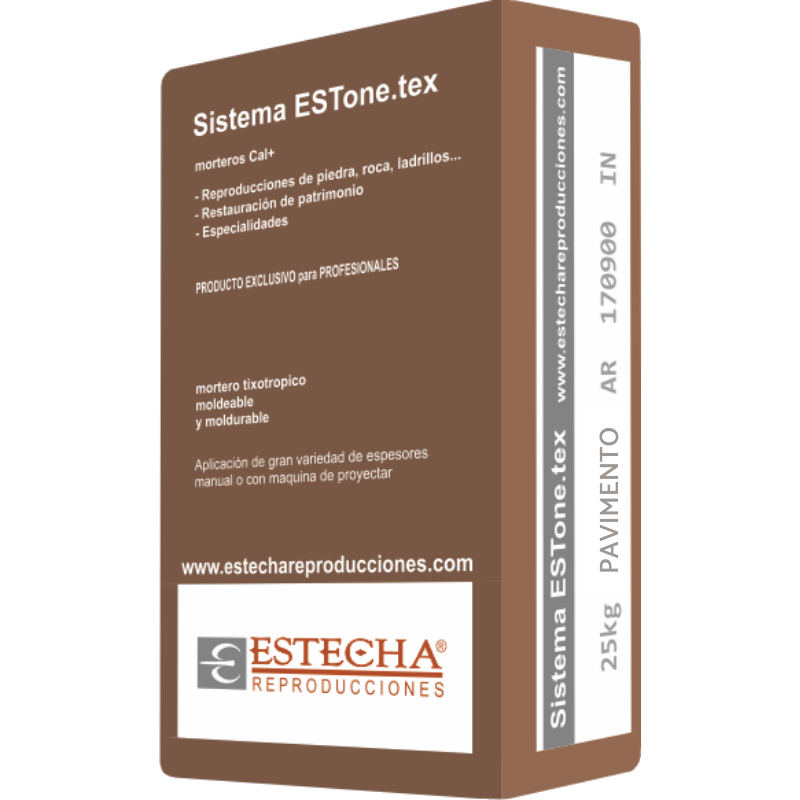
ESTonetex Pavimento
Applications
• Reliefs and slabs of various designs: theming of carved stone, ashlars and stamping with moulds
• Decorative flooring applied in one or more layers, with different finishes or textures, including non-slip finishes through texture or stamping
• Walkways, themed plazas and floors in theme parks and high-footfall spaces
• Ornamental elements, levelling of screeds, refurbishment and repair of chipped areas and corners
Technical specifications
| Packaging | 25 kg paper bag. Pallet of 48 bags (1,200 kg) |
| Reference | 1005 |
| Appearance | Powder |
| Colour | Sandstone |
| Application thickness | 10 to 20 mm (1 to 2 cm), in one or two passes |
| Mixing water | 4.25 to 5.25 L per 25 kg bag (≈ 19%) |
| Consumption | Approx. 20 kg/m² per cm of thickness |
| Application temperature | Between 5 °C and 35 °C |
| Workability of the mix | ≥ 1-2 hours |
| Grain size | 0-800 µm |
| Apparent density | ≈ 1,400 kg/m³ |
| Water absorption | < 0.2 kg/m²·min½ |
| Adhesion | ≥ 1.0 MPa |
| Compressive strength | ≥ 20.0 MPa |
| Flexural tensile strength | ≥ 6.0 MPa |
| Reaction to fire | Euroclass A1 |
| Classification | GP CSIV W2 (EN 998-1) |
| Water properties | Water-repellent. Waterproof to rainwater and permeable to water vapour |
| Shelf life | 24 months from the manufacturing date, in the original packaging, under cover and in a dry place |
Data verified in the official technical data sheet. Full technical documentation and certificates are available on request through the contact form.
Supports
Mortar screeds, concrete (treated with the EST-S Imprimer bonding bridge) and conventional cement-based substrates. Substrates must be sound, clean, free of paint residues, poorly bonded parts or substances that hinder adhesion, with suitable flatness and sufficient porosity and roughness. In hot or windy weather, dampen the substrate and wait until the water film disappears. Do not apply on cellular concrete, plaster, paint, metal, plastic or materials with low mechanical strength, nor on floors with permanent moisture or rising damp.
How is ESTonetex Pavimento mixed?
Mix with 4.25 to 5.25 litres of clean water per 25 kg bag, by hand or with an electric mixer, until a homogeneous, creamy, lump-free mix is obtained. Let it rest for 5 minutes before applying. Keep the water proportion constant in every batch and do not add other binders, aggregates or additives: excess water reduces mechanical strength and drying speed. For spray machines, the optimal water/mortar ratio depends on the machine (hose section and length) and on the weather conditions.
How is it applied?
Spread the mortar by hand or with a spraying machine, in thicknesses of 10 to 20 mm (depending on the shape of the mould or the texture) in one or two passes, and level it. Once spread, shape the volume with spatulas, trowels, jointing tools or stamping. When hardened, sand and sculpt the desired parts and, once dry, pigment with EST-26 Multilite, EST-Monocrom or EST-Multipol. To finish, apply the EST-Floor protective varnish. You can watch the application tutorial.
Observations and precautions
Do not apply with risk of frost, rain, strong wind or direct sun. Do not apply below 5 °C or above 35 °C. In high temperatures or low relative humidity, protect the surface to prevent premature drying and, once the material has set, cure it by watering for as long as possible. Contains cement: wear gloves, goggles and a mask. Professional product: always consult the safety data sheet.
Pigmentation
Once the mortar has dried, it can be pigmented with EST-26 Multilite, EST-Monocrom or EST-Multipol, and protected when the work is finished with EST-Floor.
Complementary materials
• EST-S Imprimer: bonding bridge to treat concrete before application
• Fibreglass mesh for flooring 130 g: recommended reinforcement
• EST-26 Multilite / EST-Monocrom / EST-Multipol: pigmentation of the finish once dry
• EST-Floor: water-based protective varnish for floors, applied when the work is finished
• EST-Desmoldeante: prevents the mortar from sticking to the moulds; suitable for stamped-concrete and theming moulds
Frequently asked questions
What is ESTonetex Pavimento mortar used for?
For theming horizontal surfaces: decorative flooring, reliefs and slabs, carved stone and ashlars, and stamping with moulds, with high mechanical resistance to heavy traffic. It is applied in layers of 1 to 2 cm, so it works where thick build-ups are not possible.
What is the difference between ESTonetex Pavimento and TXT, Park, Sulfo or Extreme mortars?
Pavimento is a one-component wearing-course mortar for floors, in layers of 10 to 20 mm. TXT and Park are thixotropic mortars for modelling and carving volumes, with layers of up to 70 mm and 50 mm respectively according to their data sheets. Sulfo and Extreme are the mortars for areas in contact with salt or chlorinated water. For the floor, choose Pavimento.
How much ESTonetex Pavimento mortar is needed per m²?
Approximately 20 kg/m² per centimetre of thickness, according to the technical data sheet. A 25 kg bag therefore covers about 1.25 m² at 1 cm thickness and about 0.6 m² at 2 cm; a pallet of 48 bags (1,200 kg) covers about 60 m² at 1 cm.
What thickness should be applied?
Between 10 and 20 mm, in one or two passes, depending on the shape of the mould or the texture. The technical data sheet sets a minimum of 10 mm and a maximum of 20 mm.
How long does ESTonetex Pavimento last once mixed?
Workability is at least 1 to 2 hours, according to the technical data sheet. Mix only the amount you are going to apply and always respect the water proportion.
What temperature can ESTonetex Pavimento be applied at?
Between 5 °C and 35 °C. Do not apply with risk of frost, rain, strong wind or direct sun.
Can it be applied on concrete?
Yes, after treating the concrete with the EST-S Imprimer bonding bridge. It can also be applied on mortar screeds and conventional cement-based substrates. It must not be applied on cellular concrete, plaster, paint, metal or plastic.
Can it be stamped with moulds?
Yes, it is designed for that. It is moulded or stamped while the mortar is fresh, with spatulas, trowels, jointing tools or rock and stone texture moulds; the EST-Desmoldeante release agent prevents the mortar from sticking to the mould and is suitable for stamped-concrete moulds. Once hardened, it can be sanded and sculpted.
What strengths and fire rating does it have?
Compressive strength ≥ 20 MPa, flexural tensile strength ≥ 6 MPa and adhesion ≥ 1.0 MPa, with Euroclass A1 reaction to fire and GP CSIV W2 classification (EN 998-1).
How is the finished floor protected and coloured?
Once dry, it is pigmented with EST-26 Multilite, EST-Monocrom or EST-Multipol. When the work is finished, the technical data sheet indicates applying EST-Floor for greater protection.
👉🏻 Remember that our shop is a DIGITAL CATALOGUE. You can request a quote if you are in Spain, or find our official international distributors.
Solicitud de presupuesto
-- or --